Monday, November 27, 2017

Teachers Educating Across Cultures in Harmony (TEACH) Fellowship, Bahrain


Over Thanksgiving Break, I was fortunate enough to participate on a Teachers Educating Across Cultures in Harmony (TEACH) Fellowship to the Kingdom of Bahrain. The fellowship was financed,  organized, and administered by the Bilateral U.S. Arab Chamber of Commerce, an organization whose aim is to foster strategic connections, economic growth, and educational advancement with key decision-makers in the United States and the Middle East/North Africa. In order to realize this goal, the Chamber has developed the TEACH Fellowship to the Kingdom of Bahrain to help strengthen ties between the two nations.  The program's mission is to develop mutual understanding and respect between both countries with the hopes that educators will then return to their classrooms and communities to spread goodwill. 

Interestingly, upon telling folks about my trip, I was usually met with confusion. "Where is Bahrain?" they would ask.  This small island country is situated in the Persian Gulf, just east of Saudi Arabia and north of Qatar: 


This tiny but fascinating country is home to approximately 1.5 million people in 295 square miles. For reference, LA County is home to 10 million people in 502 square miles!

Bahrain is a small but charming country that is definitely worth the visit!


Over four jam-packed days, myself and  seven educators from around the country toured cultural and historical sites, met with prominent non profits and companies, and visited schools. I was flattered to be part of such an accomplished group of teachers-One lady was named 2015 Wisconsin State Teacher of the Year, and another was awarded a $175,000 grant from the state of North Carolina to overhaul math education in her school district! We were an exceptionally well-travelled group as well, with every member participating on multiple teacher travel fellowships. It was a truly phenomenal group of people. 


Our first site visit was the to the Shaik Ebrahim Bin Mohammed Al-Khalifa Center for Culture, a series of exhibits and galleries situated in turn-of the century antique buildings. The center was established in 2002 as a gathering point for intellectual thought, intercultural exchange, and research. Since it's inception, it has hosted more than 200 speakers, philosophers poets and thinkers on a variety of topics related to the Arab World. The physical spaces were a stunning display of antiquity and modernity: 


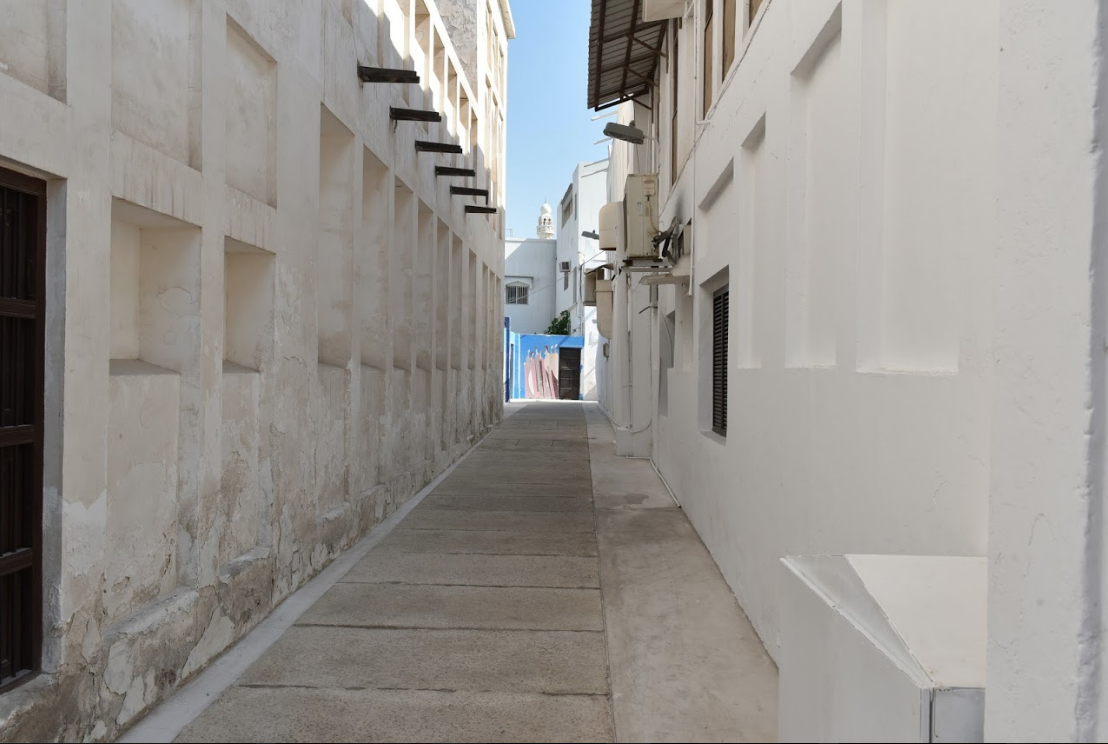
An example of the narrow alleyways that criss-cross the neighborhood. 


One of the many rooms for study. Note the pictures of the royal family on the back wall. 


Books written in Arabic. Like other Semitic languages such as Hebrew, books are read from right to left. 


A date palm in a traditional turn of the century building. Date palms are an integral part of Arabic culture because of the wood and (delicious) dates they provide. 


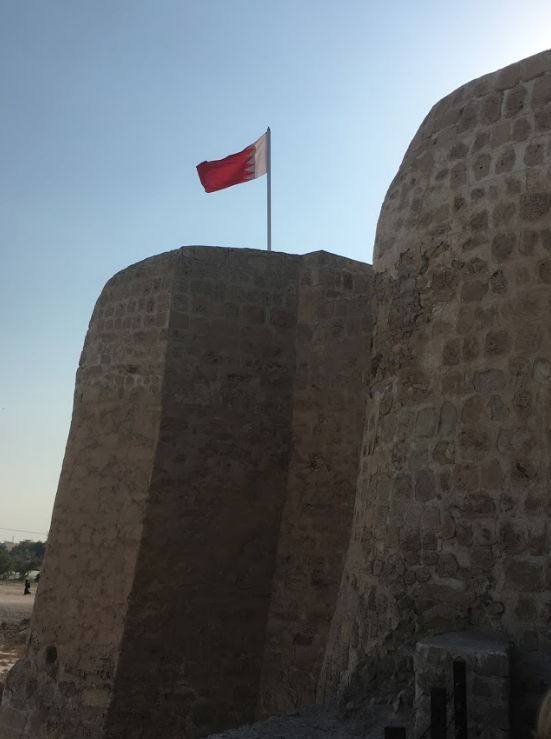
One of the most impressive sites we visited was the Qal'at al-Bahrain (قلعة البحرين‎)  Bahrain Fort. Given it's strategic position on the coastline of a heavily travelled trade route, the Bahrain Fort has been occupied by various peoples for the last 5,000 years, including the Dilmun Civilization and the Portuguese: 


The entrance to the Bahrain Fort. It was named a UNESCO World Heritage Site in 2005


The Flag of Bahrain. The triangles on the white represent the 5 pillars of Islam and the white represents mother of pearl, a valuable natural resource indigenous to the area. 


The 

One of the most prominent themes we encountered on our trip is the controversial process of "reclaiming" land in Bahrain. For a small country with a booming economy, real estate is at a premium. In order for the economy grow, the government literally fills in the sea, creating new landforms:

The left image shows Bahrain in 2002, and the right image shows Bahrain in 2014. Note the tremendous addition of new land in the northern part  of the country. 


Environmentalists say that land reclamation is harming the delicate ecosystem along Bahrain's coasts, but development agencies and the government argue that more space is needed to grow the economy. 


This impressive skyline was built entirely on reclaimed land. The Bahrain World Trade Center on the left has won numerous awards for its creative architecture. 


After our visit to the Bahrain Fort, we went to the Bahrain National Museum, which sits on a piece of reclaimed land. Established in 1988, the museum was constructed at a cost of $30 million, and houses treasures and antiquities from the island's past: 


A recreation of a pearling vessel. Before modern technology, divers would hold their breath for up to 3 minutes as they collected mollusks. 


A Qu'ran made of Mother of Pearl. 


One of the most fascinating aspects of the museum was the history of pearling in the region. I had noticed that pearls play a prominent part of the Gulf region's culture: 


By 1928, revenues from the pearl trade accounted for approximately 90% of the country's revenue!


The Great Depression led to a precipitous decline in the demand for pearls, and fake pearls from Japan and China decimated the Gulf region's pearl industry. By 1954, there were only 11 pearling boats. Fortunately, oil was discovered in Bahrain in 1932, and has become the country's leading export. 


Interestingly,  the only available wood in the region are palms. Since summers reach a stifling 120 degrees,  homes were built of porous palm fronds. In addition to palm dates, the fronds were a crucial part of Arabic culture and civilization. 


The next day,  we visited the Al Fateh Grand Mosque. Built in 1987 and covering a whopping 6,500 square meters, this mosque can hold over 7,000 worshippers at a time! It was a sight to behold: 

Not surprisingly, the Al Fateh Grand Mosque is the premier tourist destination in Bahrain. This place is stunning!


A hallway made of imported Italian  marble 

This chandelier was constructed and imported from Austria. The dome in the background is the largest fiberglass dome in the world. 


During our visit, the Mosque was hosting a world qualifying competition. Men from around the Arab World gathered to compete to see who could recite the longest memorized passage from the Qur'an. Judges marked them for errors and omissions. 


That night, we ventured to the Bab Al-Bahrain Souk. This tightly packed commercial zone featured competing merchants gesturing for our business. It reminded me very much of Santee Alley in Los Angeles. 

A spice vendor selling food stuffs from the Near East and South Asia. 

A typical street scene at the Souk. Interestingly enough, most of the goods sold were not from the region, but rather from India! Approximately 50% of Bahrain's residents are immigrants from India.


A merchant decided to dress me in a Keffiyah, the traditional headwear for Arab men. 


Bahrain is clearly unaffected by globalization. 


In addition to cultural and religious site visits, we also had the opportunity to visit two different schools in Bahrain. The first school we visited, Bahrain Bayan, opened in 1982. This private, K-12 school serves mostly Bahraini and Saudi Arabian children, but all classes are taught in English. High School students use the International Baccalaureate curriculum.


The Bahrain Bayan School is the premier private school in the country. Almost every student graduates bilingual in English and Arabic, and many gain admission to top universities in the UK and the US. 


Faculty and Staff of Bahrain Bayan with TEACH Fellows. Funny enough, Mr. Hamoud, the gentleman next to me in the front, used to be a Corrections Officer in LA for the California Youth Authority! Needless to say, as Dean of Students at Bahrain's top private school, he doesn't have the same disciplinary problems he had back in Southern California. 


We also had the opportunity to visit St. Christopher's School, one of the oldest and most prestigious British private schools in the Middle East. This school mostly serves British expatriate children whose parents are working in Bahrain or Saudi Arabia in the oil and gas or international finance industry. According to the headmaster, most companies will subsidize tuition for up to 3 children to attend private school while abroad. Although classes are taught exclusively in English, the student body is exceptionally diverse, with over 60 different countries represented.


Our student tour guides told us that most students stay for approximately 2-4 years before relocating to another country due to their parents jobs.  Most also go on to top universities in Europe and the UK.


We also visited with a few non-profit education organizations working to close the achievement gap in Bahrain. The first non profit we visited was INJAZ Bahrain, an organization whose aim is to inspire and prepare young Bahrainis to succeed in the global economy. INJAZ brokers relationships between  Bahraini professionals in a variety  of fields and students in order to help youth grow their skills in the areas of entrepreneurship, personal finance, and public speaking.


Like other nonprofits around the world, INJAZ Bahrain struggles for funding, and due to low salaries in the non profit world, struggles to find and retain good talent. Nonetheless, their impact is tremendous: 32,000 students have been connected with 1,200 professionals.


We met with the Bahrain Economic Development Board, whose mission is to promote economic development in the country. They also release an annual report on the state of Bahraini education and offer solutions on ways to strengthen the education infrastructure  of the country. Their annual report, which documents everything from enrollment to college graduation rates, offered a unique glimpse into the country's education system:
Boys and girls are segregated by gender after the age of 10, but boys schools vastly underperform girls schools. Boys also graduate from college and university at disproportionally lower rates than girls. 

Men are disproportionally under-represented in the teaching field in Bahrain, a similar problem in the US.  


In addition to cultural, educational, and non-profit organization visits, we also met with the Gulf Petrochemical Industries Company. Along with being the largest ammonia and methanol company in the country, they are also a leading member of the US Bilateral Chamber of Commerce and a large funder of the TEACH Program. The next time I use cleaning solutions, I'll thank GPIC!


Even though the Gulf region hosts a number of expatriates working in the oil and gas industry, GPIC proudly boasts that 90% of it's employees are Bahraini.


One of the most impressive aspects of GPIC was it's commitment to environmental sustainability, corporate responsibility, and employee development. In addition to hosting a women's empowerment Day each year, GPIC encourages employees to volunteer, (and many choose to volunteer with INJAZ Bahrain!) and has won a number corporate environmental sustainability awards as well.


Our last stop of the trip was to Peninsula Farms, one of the largest greenhouse farms in the region. They produce a variety of products including vegetables , goat milk, goat cheese, and goat milk. Given the harsh weather conditions during the summer, (with averages over 100 degrees!) it was an impressive facility:

Peninsula Farms founder Grahame Dunling and his farm's products. The son of the Bahraini Ambassador to the US, Dunling grew up in Washington DC and is a die-hard Redskins fan and organic farmer in the desert.  
Peninsula farms have 45,000 sq/ft of growing area and is operational year-round and is one of the largest sustainable, all natural greenhouse farms in the Middle East!


Overall, our 4 day excursion to the Kingdom of Bahrain was an enlightening, educational experience. Bahrain is a country that delicately balances antiquity and modernity, where tradition and globalization meet. Thank you to the US Bilateral Chamber of Commerce and the other Fellows for an unforgettable experience!

I also published an op-ed about our trip in the Huffington Post. Check it out:

https://www.huffingtonpost.com/entry/globalizing-your-classroom-to-reduce-bullying_us_5a294c99e4b09ee35b8ae6b3


And fellow Matt Cottone made a short video documenting our trip:


Until next time...


Thursday, September 8, 2016

Paradise in Panama

As I was planning my itinerary between Los Angeles and Quito, Ecuador, I noticed that my flight was routed through Panama City, Panama. Since my airfare was fully funded through the Earthwatch Institute, I decided to ask how much money it would cost to extend my layover in Panama City from 3 hours, to 6 days. The answer I received was astonishing:

$150.

In other words, all of my airfare between LA, Ecuador, and Panama would cost a grand total of $150. Needless to say, I quickly added a 6 day layover in Panama to my itinerary! Luckily for me, both Ecaudor and Panama use the US dollar, so I didn't have to worry about currency exchange.


I landed in Panama City, exhausted after a week of trekking through the Ecuadorian jungle in search of caterpillars. Anticipating this fatigue, I booked a few nights in the northern beach town of Bocas del Toro for some much needed R & R. Located in an archipelago on the northeast corner of the country, this 4,600 square kilometer province is a popular destination for surfers, water sports and  sailing enthusiasts.

The Province's capital, Bocas Town, sits on the water. Most hostels, restaurants and shops have docks that lead out to the ocean

I booked my stay at the Selina hostel, which has a wonderful deck that looks out over the ocean.  photo courtesy of Hostel World.

While in Bocas, I decided to explore the neighboring islands via lancha, (water taxi in Spanish):
The caribbean water was the warmest I've ever experienced. It was absolutely amazing!

Isla Bastimientos, a protected habitat for a variety of aquatic life

I stumbled upon this bar and restaurant on Red Frog Beach during my adventures. Unfortunately, the next boat back to my hostel didn't leave for another four hours, and mixed drinks were $3 US. It was absolutely awful being stuck there! 

One of the most memorable experiences I had during my time in Bocas was an unplanned adventure to Polo Beach. After speaking with some locals about cheap, authentic places to grab lunch, they informed me of an eclectic hermit named Polo and his delectable lunches. After a 40 minute walk along a secluded trail on a sparsely populated island, I finally found Polo and his beach. Polo speaks Wari Wari, a dialect of Creole English. According to him, he's been living on the beach for 50 years, and I can attest that he cooks up a mean chicken and rice! If you find yourself in Bocas, I highly suggest visiting Polo and his beach.

After a few nights in Bocas, I hopped a flight back south to Panama City. I booked a hostel in the historic neighborhood of Casco Viejo, located on the Pacific side of the Panamanian Isthmus. The Casco Viejo is the second oldest neighborhood in Panama City, dating back to 1673. In 1997, it was designated a UNESCO World Heritage Site: 
The ruins of the Church of Santo Domingo, which suffered a devastating fire in 1756.

A typical street scene in Casco Viejo

The Church of La merced 

It's centuries-old streets are punctuated with colorful, modern street art


The Catedral Metropolitana 
Casco Viejo comes alive at night, as the streets fill with locals and tourists alike patronizing restaurants, bars and clubs


A typical narrow street in Casco Viejo, designed long before and without any consideration for the automobile
Cassco Viejo as seen from Ancon Hill
The Palacio de las Garzas, where the president of Panama lives. Photo courtesy of Wikipedia


One of my favorite destinations in Panama City was the Panama Viejo.  Constructed in 1519, Panama Viejo is the first European settlement on the Pacific Ocean. By 1670, the settlement had over 10,000 permanent residents, making it one of the largest settlements in the Americas. In 1671, pirate Henry Morgan and 1,500 soldiers sacked and burned this coastal Spanish city to the ground.  This illegal display of aggression  violated a peace treaty between Spain and England, resulting in Morgan's expatriation back to England for punishment. In a cruel twist of irony, Morgan feigned ignorance of the treaty, and was instead knighted by King Charles the II. Morgan was then given the position of Lieutenant Governor of Jamaica.  He has since been immortalized through the Captain Morgan brand of rum, whose mascot bears his likeness.


This diorama shows an approximation of 17th century Panama City


The bell tower, which can be seen in the diorama photo on the right side. In order to build the tower, experienced stonemasons needed to be hired and transported from Spain to Panama. Apparently, after the first convoy sunk, (resulting in the deaths of all aboard,) a second convoy was sent. This convoy sunk also, which delayed construction even longer, ultimately resulting in the hiring of local stone masons instead.


A view from inside the bell tower, towards the modern Panama City skyline. A stark juxtaposition of antiquity and modernity

As I wandered around the Panama Viejo site, I tried to imagine the horror that must have unfolded as Henry Morgan sacked the city. I think it must have been quite similar to Pirates of the Caribbean ride at Disneyland: you know, the scene where the pirate ship is floating outside the Spanish town, barraging it with cannon balls? Eventually, the pirates over run the town's defenses, and proceed to sack, loot and burn the place to the ground.


I'm pretty sure that Morgan's sacking of Panama City in 1671 looked exactly like this scene from the Pirates of the Caribbean ride at Disneyland. Minus Jack Sparrow, of course. 
A few miles from Panama Viejo is the Panama City skyline, an example of modernity at it's finest: 

According to my taxi driver, a condo with an ocean view sells for 250-300,000 USD

A view towards the skyline with the Panama flag in the foreground 

Any trip to Panama would be incomplete without visiting it's most famous tourist attraction, the Panama Canal. Built over a span of ten years, and finally completed in 1914, the Panama Canal stands as a testament to modern engineering. I traveled to the Panama Canal Visitors center and took in this modern marvel in person: 

A view of the Miraflores Locks

Construction of the canal was incredibly expensive: Not only did it cost $375,000,000, it also resulted  nearly 20,000 French and 6,000 American worker's deaths during  it's construction. However, those lives were not lost in vain: nearly 14,000 ships pass through the canal every year, making it one of the busiest canals in the world. 

Panama is a hot tourist destination, and rightfully so. This place is awesome! 

Overall, my trip to Panama was incredible. If you find yourself with a layover in Panama City, I highly recommend the trip!

Until next time...

Earthwatch Ecuador

This summer, I was fortunate enough to participate on an Earthwatch Teacher Fellowship to Ecuador.  The fellowship is organized, administered and funded through the Earthwatch Institute, an environmental advocacy organization whose mission is to engage citizens in the scientific research process and raise awareness of critical environmental issues. One of their most popular initiatives is teacher education and outreach. This means fully-funded trips for educators to experience scientific research in the field with the hopes that they return to their classrooms and teach their students. 


Our Earthwatch trip embodied the idea of citizen science. The idea is simple:  anyone, with the guidance of a professional scientist, can participate in and contribute to the scientific research process in meaningful ways. This symbiotic relationship between researcher and volunteer provides increased data collection and manpower for the scientist, and an unforgettable, empowering experience for the volunteer. In the case of my colleagues and me, the experience also meant innumerable teaching opportunities for our students.

Myself and 12 other teachers spent a week at the Yanayacu Biological Research Station in Napo Province, Ecuador to study the effects of climate change on the caterpillar population. Anybody can rent space at the station, which provides room and board facilities as well as research equipment. The station sits on the edge of one of the most biologically diverse cloud forests in the world, providing ample opportunities for research. While we were there, a number of teams from various universities were simultaneously carrying out their own research projects as well. 


The Yanayacu Biological Research Station

This was home sweet home for a week

The weather was rather unpredictable, but consistently cold and wet. Torrential downpours would spontaneously appear and disappear. The weather never rose above a chilly 60 degrees, and we didn't see the sun for a week. 


This was the view from my dormitory balcony

Our group was assisting a longitudinal study about caterpillars in Ecuador. The actual research aims are complicated to explain, but the Earthwatch website did a wonderful job summarizing our project: 


"The Climate Change and Caterpillars project in Ecuador examines factors that affect interactions among plants, caterpillars, and their natural enemies. This is an important area of study for both agricultural and basic ecology. This three-tiered study system allows for insights into “tri-trophic” interactions— in other words, it examines the relationships among three distinct levels of the food web. 

The natural enemies of caterpillars that the project studies are called “parasitoids.” They include many species of wasps and flies that kill caterpillars by depositing their eggs on them. This ensures that the parasitoids’ offspring will have both a safe environment in which to grow (inside the caterpillar) and a good supply of food (caterpillar tissue). We are rearing caterpillars of over 300 species and recording the mortality caused by the parasitoids. In addition, we isolate specific chemical compounds from some species of caterpillars and food plants to examine them as potential defenses against parasitoids.


The white worm-like creatures on the top part of the photo are parasitoids. They lay their eggs in the body of the caterpillar, and feed on it's host from the inside out. Parasitoids were the inspiration for the most famous scene in the movie "Alien," where the alien pops out of the guy's chest.


In order to collect the caterpillars, we hiked through the cloud forest, and searched high and low for these furry little guys. The biodiversity was absolutely breathtaking: 


Hiking through the cloud forest in search of caterpillars


We routinely crossed these wood bridges. They're covered in moss and quite slippery!


The flora was so thick that sunlight barely reached the ground

The plants that inhabit the forest floor are forced to grow larger in order to capture the little sunlight that reaches the bottom


Below are a few photos of the various species of caterpillars we collected: 


After the caterpillars are collected and bagged in the field, they are taken back to Yanayacu. From there, they need to be photographed, catalogued, and reared: 


The caterpillars need to be photographed to document their current instar, or pupation period. It's tedious work that requires  great attention to detail.  I was not particularly good at this.


The caterpillars live in a plastic bag until they pupate into moths. Naturally, they defecate in the bag, as any living creature would. This necessitates regular cleaning, or "rearing" of the caterpillars, which includes stocking the bag with fresh leaves and cleaning their feces. I was very good at this.

Notice those round brown pellets below the caterpillar? Those things are poop. For reference, that caterpillar is the size of your index finger.

After the caterpillars pupate into moths, they are then placed into the freezer to meet their demise. Afterwards, they are pinned for display. This is the first step of pinning a moth. Much like photographing, this is tedious, detail-oriented work. I was not very good at this either.


The finished product. Many of these moths are sent to the Natural History Museum in Quito, Ecuador to be displayed!


Much like the caterpillars, the diversity and vibrancy of the moths was astonishing: 


While the Earthwatch trip was an incredibly enriching personal experience for myself, the true aim of the project is to increase awareness of global environmental issues in K-12 classrooms. In order to receive our reimbursements for the trip, we need to plan, design, and carry out a lesson plan that related to our Earthwatch experience. I taught a lesson about descriptive language and moths:
First, I gave each student a picture of a moth from my Earthwatch Ecuador trip. I then taught them the different anatomical parts of the moth, and had them identify each part on their own moth


Next, using a teacher provided graphic organizer, I had each student describe their moth in detail. For example, this student said that "the hindwing has a zig zag along it and it's faded yellow and green." 

Finally, I gave the description to a student who hadn't seen the original moth picture. Then, they draw the moth according to the description provided. Afterwards, I hand the drawing, along with their description back to the original author. The original author then compares the drawing with the picture. What could they have described in more detail? 


Overall, the students very much enjoyed working with moths, and found the Earthwatch trip to be quite interesting. We had an insightful discussion about the man-made and natural threats to moths and butterflies, and they used lots of Tier III, content-specific vocabulary as well. Hopefully they also learned something about moths along the way!


In addition to my lesson plan, I also published an article about my Earthwatch trip. Check it out!

http://laschoolreport.com/commentary-a-caterpillar-curriculum-the-importance-of-environmental-education-in-k-12-urban-classrooms/


Until next time...


Until next time...

Thursday, July 7, 2011

Back to the Beginning

Back in the Fall of 2009, myself and other Pitzer College Seniors spent countless hours crafting our Fulbright Applications, in hopes of traveling the globe in the name of intercultural understanding. Our fantastic Fellowship Advisors supported and guided us through the application process, paying special attention to the important Personal Statement. As outlined on the Fulbright Commission website,


" The Personal Statement should be a narrative giving a picture of you as an individual.  Remember, applicants are not interviewed on the national level. The Personal Statement is your opportunity to “talk” about yourself and to tell the committee more about how you came to this point in your life and where you see yourself in the future.  There is no single “right way” to approach the Statement; rather each candidate will consider what they think is important for people reviewing the application to know about them.
The Statement can deal with your personal history, family background, influences on your intellectual development, the educational and cultural opportunities (or lack of them) to which you have been exposed, and the ways in which these experiences have affected you.  Also, you may include your special interests and abilities, career plans, and life goals, etc. It should not be a recording of facts already listed on the application or an elaboration of your Statement of Grant Purpose.   It is more of an autobiography, and specifically related to you and your aspirations. "
 

14 drafts later, I crafted this: 

***

The day my two moms met was one of the most moving, enlightening, and surreal days
of my life. Not only did I view the world a little differently afterwards, I also learned firsthand that education is not limited to classroom lesson plans.

While I have a great relationship with my American mom, I was eager to have four
months of freedom during my study abroad in Ecuador. This was my opportunity to escape the heated deliberations and head butting that characterized our lively relationship. I would escape the nagging and constant lectures on responsibility and self reliance. Although I want to follow in her footsteps as an educator, a break was well needed. 

One thing was certain. I didn’t escape the nagging. I sure didn’t escape the debates. And
the lectures were more poignant than ever before. The only thing that was different was the
language. If Susan Brown were Ecuadorian she would be Cecilia de Cherréz Velasco, a woman who deeply cares for her “gringo” host children with sincerity only matched by my own mother. If my mother were there with me, she would worry that I would catch a cold in the torrential Andean rains and would hound me on the values of responsibility. Good thing she wasn’t with me, because her clone was doing a perfectly fine job herself.

When my American mom came to visit and my two moms finally met face to face, a
language barrier was evident. Although they could not verbally communicate with one another, they conversed with ease as they effortlessly crossed cultural and linguistic barriers. When I offered my American mom some delicious, yet questionably sanitary street food one day, she told me that the next time I see Cecilia I should ask her if it was safe to eat. Seeing the imminent problem, (as my host mom made me promise to never eat street food) I avoided the question when my two moms met. But my American mom insisted, saying, “Joshua Alan Brown, ask your mother if I can eat the food!”

I responded, saying, “Mom, trust me, it’s fine.”
However, much to my surprise, Cecilia was one step ahead of me.
What are you talking about?” she inquired in Spanish.
“Oh, nada, Ceci, todo bien.” I calmly answered, trying to keep my cool.

The next thing that happened was one of the most surreal moments of my life. Either my
American mom suddenly learned Spanish, or she can read minds, but they both looked at each other with a twinkle in their eye and started yelling. “You gave your mother street food!” Cecilia exclaimed. When one mother would raise her voice at me, the other, completely unaware of what was said, inferred the subject matter and then raised her voice as well, almost mimicking word for word what the other was saying. When they finally finished and the laughing stopped, Cecilia looked at me and said in Spanish, “You are your mother’s son.” No translation was necessary.

It was then I finally got it. I watched my two role models, people I aspire to emulate,
accomplish something so few people can do. They formed a deep meaningful, relationship that spanned language and culture by connecting on a very simple idea. Fortunately for me, I was the very thing that connected them. Because of my personal connections with Cecilia and my mom, they were able to relate to each other based on their relationship with me. But the lesson went a little deeper than that. This experience served as a primer for the very thing I hope to do as a teacher, which is giving people a way to learn about their similarities. I learned that meaningful bonds can open the door to numerous educational opportunities and can transcend even the largest of differences. Even to this day, my two moms still stay in touch via email, with me conveniently translating their letters. Education can indeed continue long after the school bell rings, and is certainly not confined to the classroom.

*** 

Jokes aside,  as I reflect back on the past 12 months, I wonder if I was able to accomplish the goals I set out for myself in my Personal Statement. When I try and quantify or even qualify that question, I'm simply at a loss for words, much less an answer. 

 I guess all I can say is don't worry mom, I've only gotten sick from the street food once this year. 


Until next time...

Sunday, June 19, 2011

Tales from the Host Family

After 11 months living with my homestay family, we've grown quite close to each other. I feel that in many ways,  the role of "host son" and "son"  has been blurred. My temporary family member status has not stopped them from fully adopting me, and I couldn't be more grateful. 

Below are a few short snippets that highlight some enlightening aspects of my experience with the Chang Family.

***
My host dad and I have developed a particularly strong relationship over the past year.  Our relationship has flourished for a variety of reasons. Not only does he speak impeccible English, but Chang Jin Ho is also a  Renaissance Man. At the ripe old age of 35, he has served as a great older brother to me, offering invaluable advice about a variety of issues.  

Every now and then, when my host mom and sister have gone off to sleep, my host dad calls me out into the living room to chat over beer and snacks. I particularly look forward to this "male bonding time" between (host) father and (host) son, especially since these conversations prove to be quite entertaining. Usually we drink alcohol, watch Ultimate Fighting Championship together, and chat about everything from politics to the latest UFC Pay Per View Event. But this last time, the conversation started a little differently than normal:

"Joshie," my host dad said pensively, as he took a swig of his beer.

"You know, I am very good at many things in life: When I was soldier in the army, I was the best with gun. I was very accurate. When I studied Englishy, I studied very hard. I speak English very well. I traveled all over the world: I lived in Canada, went to Germany and Italy and Hungary, and lived in Israel. I am also very good athlete: I can play soccer very well, and although I am old, I still run fast. But there is one thing I am very bad at."

Not one for humility, my host dad is, to be fair, a very talented individual.  He is still a tremendous athlete. For little formal training with the language, he speaks impeccable English. He is informed on current events.  And he's a very dedicated family man. But alas, no man is perfect.

Staring pensively into his empty glass, he said, "one thing I am very bad at, Joshie."

I sat there, bracing myself for something serious. We've talked about a number of heavy issues before, such as coming of age, marriage, and children. But little did I know the severity of his problem.

"Woman. I do not understand woman."


 Although we come from different countries, speak different languages, and practice different customs, I am always amazed at the minute aspects of daily life that weave the common thread of humanity through us all. I've reached this ephiphany a few times this year, when piercing moments of clarity shed light on the human existance. And they always seem to come at the strangest of times, in the strangest of ways.

Instead of offering advice, I pondered the significance of the moment. For some people, intercultural understanding happens very overtly- a major breakthrough in communication, or a unspoken noble act that is acknowledged by all. Maybe they joined a Taekwondo class, or tutored North Korean refugees. For me, at that very moment,  I learned a supreme lesson-

The old addage really is true everywhere in the world: "You can't live with them, but you can't live without them."


***

The scene: A typical evening at the Chang Residence. My host mom just put my little sister to sleep, and I am putzing around in my room, doing nothing productive.

Around 8:30pm that night, as I was fiddling around on my guitar, my host mom bolted into the house as if being chased by the Devil himself.

"FIRE!! FIRE!!!" She exclaimed.

I immediately dropped what I was doing and rushed outside. As I turned the corner outside of our house, I discovered a menacing conflagration of epic proportions. The once unassuming field behind our house was ablaze in a fiery dance of flames that would make a pyromaniac jealous. As smoke bellowed towards my living room window, I envisioned the charred remains of my most prized possessions among the rubble of my homestay. What would I do if my house burned down? Where would I live? What would I do?  How the heck did I not notice this impending doom creeping towards my bedroom window?What about my Mac? It's still under warranty, right? If I could only save one thing, what would it be?  My Ipod or my- Errrrrr, maybe I should do something about this?

Like any good host son, I immediately jumped into action. Along with the other middle-aged men in the neighborhood who came out to help, we formed a relay line to bucket sand and water on the fire. 10 minutes later, the blaze was extinguished, and the day was saved.

Talk about being a Cultural Ambassador, right? Other Fulbrighters may have formed meaningful reationships through serving their community, or participating in local customs, but I SAVED my homestay from a blazing inferno!

Little did I know, the real heat would start when my host dad got home. After investigating the scene, he wrote off the event as nothing more than a gross over-reaction on the part of my host mom.  As she explained every second of the terrifying ordeal to my host dad, he casually perused the newspaper.

 "Thats nice, honey." He mumbled, unperturbed by the raging conflagration that struck mere hours earlier.

And with each disinterested nod, more fuel was added to the fire. As the old saying goes, "Hell hath no fury like a woman scorned."


That night, after my host mom and sister went off to sleep, my host dad called me into the living room to chat over beer and snacks.

"Joshie," my host dad said pensively, as he took a swig of his beer. "one thing I am very bad at..."


Until next time...