One of the designated study trips is a rural homestay with an Indigenous family for 10 days. The experience is designed for us to contextualize our studies of the Indigenous community of Ecuador, and again, practice our Kichwa. It is pretty much a mini-homestay- we have host families, program activities, field trips, and classes. We are supposed to live exactly the way the family lives, and participate as an active member of the family. It proved to one of the most culturally enriching activities of my life.
ABOUT MY PROGRAM
We lived in the community of San Clemente, which is about 2 hours due north of Quito and about a half hour bus ride from the medium sized town of Ibarra. Interestingly, the town developed as a site for ethno-tourism, that is, tourism that is more "socially responsible" where the tourists genuinely get to know the local culture through lived experiences instead of gawking at the locals and snapping photos. Back in 2000, Ecuador switched from it's own currency, the Sucre, to the American dollar. (which is still the currency of choice today.) In a somewhat confusing decision by the then president, the country fell into a deep recession. Banks closed, and thousands of people lost millions of dollars. The indigenous community was hit especially hard. As was the problem with the whole country, physically getting American dollars was really difficult. And due to the socio economic position of the indigenous community in Ecuador, they were the last on the totem pole to get greenbacks.
So the Community of San Clemente decided to go into the business of ethnotourism. With a little help from some Americans, the community as a whole began to market itself as a site for cultural exchange. Slowly, the community built up it's client list and now hosts more than 10 tourists a week. It is optional for families to host tourists, and they are not expected to change their lifestyles at all, only to include their guest in the daily activities of the families. It explicitly says in the brochure that all guests are expected to contribute to the family dynamic. If it means killing a chicken for lunch, then so be it. But financially, the community has risen to one of the more wealthy indigenous communities in Ecuador.
MY HOST FAMILY
We arrived November 9th, and were immediately introduced to our families. I lived with the Pupiales family, which consisted of my 15 year old brother, Lenin, my mom named Victoria, and my dad named Galo. We lived in a house my dad built 20 years ago.

My house
My house was really humble. It had a living room, a bathroom, two bedrooms, and a kitchen. I had my own room while the rest of the family slept in the same room. I would say the whole house was no more than 900 square feet.

My bathroom. The device above the water spicket in the shower is the water heater. Sometimes it works, sometimes it doesn't. And when it doesn't, the water is cooooold.

My living room. The roof is made of industrial size advertising paper, hence the shiny appearance.

View from the living room window.

My bedroom.
While they don't have a lot of "stuff," they are extremely happy. They have plenty of food, clothing, a roof over their head, and even enough love for me. They do not live comfortable, but rather practical. (But my dad has a car which is necessary for him to get to work). But their lifestyle is truly a lesson in it of itself.
My dad, Galo, is about 36. He is a bilingual elementary school teacher (in Spanish and Kichwa). He is a humorous guy, who always makes jokes. But when it comes to work, he gets down to business. He's up at 5:30 every morning to feed the cows. He's home by 2pm to eat lunch, but then leaves for his second job in the town of Ibarra. He goes to bed by 8:30 in order to do it all over again the next day. He was instrumental in giving me the full experience. He took me with him everywhere, and always encouraged me to try new things, even though at times I was somewhat hesitant. Read on to find out what I'm talking about.
My mom, Victoria, is about 33. She married my dad when she was 15 and he was 18. It is the tradition to marry young, primarily for financial security. She is a traditional Kichwa woman- Stoic, strong, inventive, responsible. She wears the traditional clothing every where she goes, Whether it's farming, milking the cows, or going into town. I didn't have the opportunity to get to know her very well, but I did admire her work ethic. She was the boss of the house. She did every domestic chore plus more. She cooked, (fantastically by the way), cleaned, did laundry, and took care of the domestic duties as well. Just like my dad, she was up at 5:30, in bed by 8:30. And they only converse to each other in Kichwa.
My brother, Lenin, is 15. I spent a lot of time with him and got to know him really well. Because my dad cannot have children, my host parents adopted Lenin from Colombia when he was 4 months old. Everybody in the community knows this except him. My host dad says it's too difficult to talk about, but I have a feeling he knows. I mean, he doesn't look like his folks at all.

My host family. My brother is wearing his school uniform, about to go off to school.

My mom in traditional clothing. She told me that everything she was wearing cost 200 American. She owns numerous outfits in different colors. Every woman in the community wears it and they wear them when they do everything; Milking the cows, cooking dinner, going into town, it doesn't matter. I asked her why she doesn't wear more practical clothes, and she told me it's because of tradition.

Rabo and Benny, the two dogs. We also have 3 cows, a few chickens, and a pig.

My neighbors llama that lives close to my house.

I also have some aunts, uncles, and cousins that live next door. I went over there frequently. San Clemente is the type of place where everyone knows each other, most likely because they are related.

My cousin Darwin and his daughter.
One of the most important lessons I learned from my host family is that pretty much, all people around the world are the same. Same fears, hopes, desires, problems. This was clearly illustrated through my family's humorous yet very familiar interactions with each other. Every morning, I was ritually awoken by my dad screaming, "Lenin!! Get up!!! Your going to miss your bus!!" And usually, my dad engaged in a shouting match with my semi conscious groggy brother. He reluctantly drags himself out of bed while my dad hounds him about his grades or that chore he forgot to do.
My dad and brother engaged in an evening ritual as well. After dinner, my dad would pester my brother over his studies, or lack there of at times. I remember one time, my brother forgot to feed the cows and my dad went off on him. He couldn't go play with his friends and had to stay in his room. My dad then hounded him some more about studying. Ahh, the glories of living with a teacher who happens to be your parent.... I truly empathized with him on that one. whether it's feeding the cows, (as in my brothers case) or walking the dogs, (in my case) our two families are pretty much the same when it comes down to it. Same issues, different scenery.
Meals were especially delicious. In Kichwa culture, it's a compliment to eat a lot. Which is absolutely fantastic for me!!! I usually ate at least 2 plates every meal, much to my families delight.
THE PROGRAM
As described earlier, we were pretty much expected to live as our families do. So, in my 10 days with the Pupiales family, I: Watched someone kill a chicken, milked a cow, caught and ate bugs, went to an indigenous rights meeting, and got beligerantly drunk with my dad. twice.
On the first day with my family, my dad tells me that we're going to a party for my cousins friend. Within hours of meeting him, my dad is shoving shots of boxed wine in my face at this party in rural Ecuador. Trying not to be rude, I graciously accepted the offer. Little did I know, I was going down a slippery slope. The more I drank, the lower my inhibitions got. Next thing I know, I'm drunk. Like really drunk. Being the only white person for miles around, I was the hit of the party. I was dancing drinking, and talking. It was the greatest ice breaker ever. I bonded with my family really well after that event, as they liked teasing me about my beligerance for the next week.

Me and my cousin, Sisa. (Sisa means "flower" in Kichwa). She is wearing traditional clothing as well. This is before I was drunk.

Apparently, my dad got a hold of my camera at some point in the night and snapped this photo. Here, I'm drinking a cup of wine in the middle of the dance floor. Alone. I can't place this event in the space time continuum, but according to my brother, I was standing there for quite a while.
On the second night with my family, my dad told me that i'm waking up at 4am the next morning to catch bugs for breakfast. You will like it he said. I had my doubts. So, I'm up at 4am, with my mom and dad. (my brother opted to sleep instead. can't say I blamed him.) On the car ride over, my dad explained to me that I was lucky to be in San Clemente at this time. There's a special type of bug, called the Katso, that only comes out in the months of November and December after it has been raining for 3 days then sunny for one. I know, I thought it was strange too, but I wasn't about to question tradition. You catch it with your bare hands and after removing the wings, fry them. They taste like chicken, he said.
So i donned some heavy duty water boots and a goofy hat to go slosh through the mud at 430am to catch bugs.

Me in my bug catching gear. The boots are worn by everyone in the community because they are very practical for doing field work in the rainy climate.
We arrived, and my mom (wearing her traditional clothes and rain boots of course,) and my dad go through the fields. He warned me to dodge cow pies and potholes, but keep my ears open for buzzing. Next thing I know, I hear buzzing all around me. I see my dad dart like a cat and snatch up these little buggers with his bare hands. I quickly follow suit, and we devise a plan of attack. We do complex maneuvers and I manage to catch about 20 of them. My dad destroyed me, catching more than 60. But the weirdest part was having them buzzing around in your hand before you put them in the bucket. At first, I got a little too excited and crushed a few in my hand.
At one point, I thought to myself, "What am I doing?! I'm running around a field in rural Ecuador at 430am catching bugs that I'm going to eat!?" But it was truly a fun experience, It was kinda like a video game.

My winnings. Little do these poor souls know, but I would later pick off their wings and throw them in a frying pan. Delicious.
That day for lunch, my mom prepared the Katsos. She sauteed them in garlic, salt, and some herbs. I hesitantly tried one, and it was crunchy. Not too flavorful, but not my first choice as well. I ate about 7 of them.

Lunch!! Served with tostada, or corn.
That day, I went to my dad's school. He asked me to teach the kids English, and luckily, I took a "Teaching ESL" class last semester. I quickly whipped up a lesson about the colors and taught 4 classes that day. My dad was really happy and I think the kids were as well. While the school is grossly underfunded by American standards, the kids seemed happy and my dad did the best with what he had available to him.

The school yard. About 60 kids attend the elementary school.

My dad's classroom.

The kids in their uniforms during recess
I went back about 3 times to teach English and play soccer with the kids. It was really cool to see the kids so excited to see me.
Another really cool activity I did was attend a meeting for the Confederation of Nationalities and Indigenous Towns of Ecuador (CONAIE). CONAIE fights for Indigenous rights and is one of the oldest groups of it's kind. My dad is very politically active in it and invited me along. He dragged my brother along, saying it would be good for him to "connect with his culture a little more" and he reluctantly went. My mom came as well. The meeting was about water rights. Apparently the federal government is selling off a majority of the local water rights to a large flower corporation, and in essence, screwing over San Clemente. So they were organizing a protest to raise awareness about the issue. It was really cool to actually see the issues I have been studying all semester.
We also went on a field trip to the town of Ibarra. Ibarra is frequented by San Clemente residents often. Many of them sell their artisan wears and fruits and vegetables in the local market. And many of the kids go to secondary school there. Ibarra wasn't really that pretty, but it did have a cool main square.

The main square. The only thing worth taking a picture of in Ibarra.
One day, my brother took me on a hike around the community. We also hiked through the neighboring community of Chiri Wasi, which means "Cold House" in Kichwa:

The trail we hiked

Some local flora

More flora
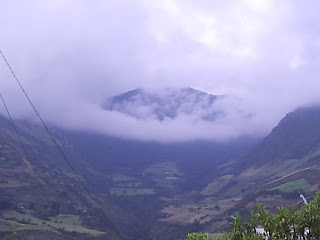
A cool mountain visible from my house
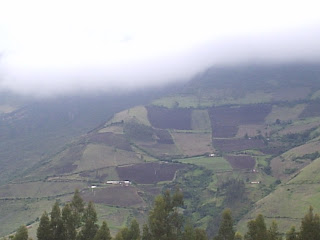


One of the many farms

A cow.
By 5pm everyday, an eerie mist would drape the landscape-


The last night there, all the students decided to throw a goodbye party. We invited all of our families to come. Each family prepared a dish pot luck style. I convinced my brother's traditional folk band to play, and while they were only together for a month, they agreed. I also got my cousin's traditional dance group to perform as well. We drank (heavily), danced and ate. At the party, we decided to sing a traditional Kichwa song we learned in our class. As with my Peru experience, It was evident that our group was just a little "different" from the usual tourists that frequent San Clemente. We studied Kichwa and that alone made all the difference in the world. As a persecuted language, it was a large compliment to the community that a bunch of Americans had the interest in learning their native language. (on a side note, there is a serious problem in the indigenous community today with language retention. A majority of the youth cannot speak Kichwa and there are some serious fears that the language could die out in a few generations. Which made our studying Kichwa all the more impressive to them).
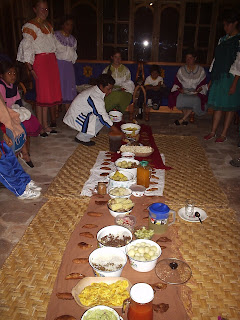
The potluck dinner. It was delicious.

My cousin's dance group.

My brother's band.
Along with the festivities, all the girls on our program wore the traditional clothing. Interestingly, the men's traditional clothing has fallen out of disuse.

The girls in their get ups.

The group!!
Goodbye was the hardest and saddest part of the whole experience. We all grew soo close to our families and parting with them was truly an emotional experience. But it was an enriching one as well. We, as a group, crossed some heavy cultural boundaries and learned a lot about each other and ourselves. It's an experience I will take with me for the rest of my life.
Next stop: Josh goes to the Amazon Jungle for a week!! Until then, Ashtakakaman!! (Adios in Kichwa)
 A typical dorm room
 Chillin on the roof of the bus
 The last boat we took to get from the bus to the station
 The stairs from the Tiputini River to the bio reserve station. With consistent rains, the water rises to the fourth staircase, about 25 feet.
 One of the many cool looking trees.
 A spiky tree my friend tried to push me into
 A leaf bug on a leaf.
 A flower and a bug
 A tree with a lot of stuff growing on it
 A jungle bridge
 Birds of paradise
 A milipede
 A blob
 another jungle bridge
 A frog
 Me doing my best impression of Tarzan, by swinging on a jungle vine.
 A vine called the "monkey's ladder" because monkeys use it to ascend to the treetops.
 A cool jungle scene
 Some monkeys that we found. One of them peed on me. It really sucked.
 The culprit. Well maybe not the exact one, but part of the same species. Although he's cute, he urinates a lot for a little guy.
 The same little buggers who urinated on me. This time, up close and personal.
 One night we went out to see Kaman, or little crocodiles. We found one. The next day we went swimming in the same river.
 Here is me spearing my friend off the boat into Kaman infested waters
 One of the catwalk towers built around a tree trunk.
 The catwalk
 A view from the catwalk
 Chillin on the catwalk in my harness and rain boots.
 One of the planks was missing from the catwalk. Good thing we were wearing harnesses!
 My Captain Morgan "Do you have some Cap'n in You?" Pose.
 Treetop view from the catwalks
 There was another ladder on top of the catwalks that allowed you to ascend to an even higher point, around 150 feet above the jungle floor.
 A view down from the highest platform
 A view from the highest platform
 our skiff
 My butterfly friends
 That day I also ate some "lemon ants," which taste like, well, lemon. I ate a lot of them because I was hungry.
 It rained there. A lot. But I was prepared with my Lacoste Raincoat, rain pants, and rain boots. Legiiiiiiiit.
 Besides a lot of rain, there were a lot of mosquitos. They loved me.


